Eve and Josh return to the house
The War of the RosesEve and Josh’s return turns a household already made dangerous by its accumulated hazards into an immediate threat to the children, and forces Oliver and Barbara to confront what their conflict has put at risk. The scene begins with Oliver alone, preoccupied with the house as the last thing he believes Barbara cannot take from him. Their arrival changes the stakes: his fear of losing his home gives way, at least for a moment, to the urgent possibility of losing their children.
Background and Arrival
Before the children appear, Oliver’s thoughts circle around the life he believes Barbara has taken from him and the house he insists is his. A muddled conversation about having been blinded by love returns to him, but it does not soften his anger; he repeats his claim on the house as though possession could restore everything else. The passage makes his fixation a direct emotional backdrop to the return: he is not waiting calmly for his family, but withdrawing into the house and into resentment.
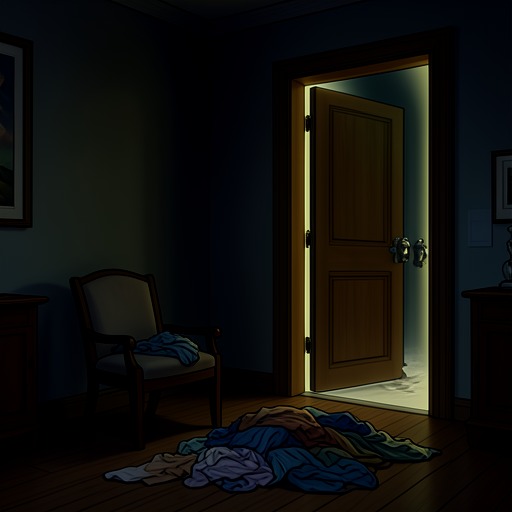
The first signs of Eve and Josh’s arrival are ordinary and unmistakable: the squeal of tires, a car motor, and the outline of a cab in the streetlight. Oliver looks through the drapes as the children emerge and stand looking at the house. Yet he does not go to meet them. He opens his mouth without finding words, then steps away from the window and lets the closed drapes plunge the room into darkness. His retreat is physical as well as emotional: he loses his balance among the bottles, reaches for a wall, and cowers in a corner, hoping the figures outside will leave.
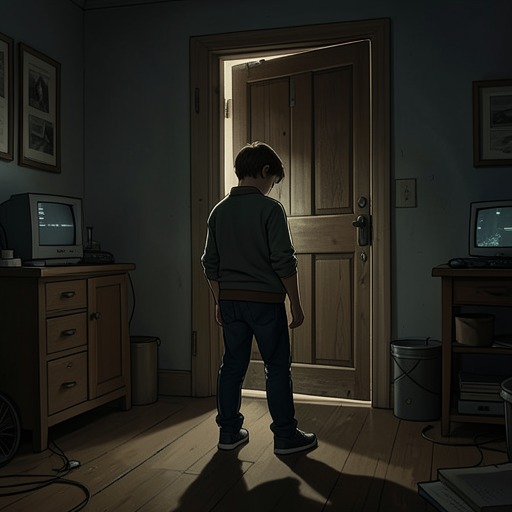
The knocking and the children’s calls make that hope impossible to sustain. Their voices identify themselves—“Mom. Dad. It's us.”—but Oliver’s frightened, disoriented thought asks who they are. The knock begins again and overwhelms their voices. Then he hears a faint whisper and a metallic sound: the door is opening. The passage delays the moment of entry through separate sounds and hesitant reactions, making the return feel less like a reunion than the arrival of people at the edge of a danger they cannot yet see.
The Entry and the Chain Reaction
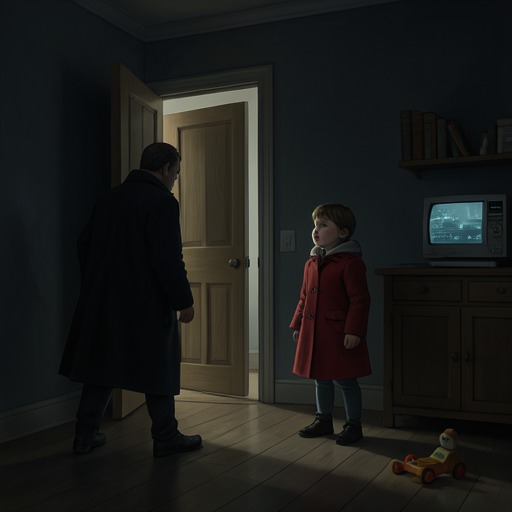
Oliver springs from the room, but his footing is uncertain, made worse by broken figures lying in his path. He falls. From behind the brass slats in the banister, he sees the door open and hears the children scream as they fall on the slick surface. They struggle upright, fall again, and grope toward the stairs. Their return brings them into contact with the house’s physical disorder before either parent can restore control of the situation.
Barbara appears on the landing above Oliver. She sees the children stumbling forward and tells them to go back, first in a voice that gives way to panic and then in a scream. Eve and Josh recognize her and call “Mom”; trying to reach her, they tear at the stair carpet for balance. The carpet, untacked, gives way. Cast-iron pots roll forward in an avalanche, their clanging joined by clock chimes that suddenly boom in an abrasive rhythm. Pictures fall from the walls. The scene’s danger is not produced by one deliberate action in the moment: the slick surface, loose carpet, pots, chimes, and falling pictures combine into a chain of physical consequences. Eve and Josh press themselves against each other and only just escape the pots.
The Parents’ Response
Barbara’s first response is to send the children back, away from the stairs and the cascading objects. Her fear is visible in her frightened face and panicked voice. Then she looks down at Oliver and implores him: “Save them, Oliver. Our children.” The appeal names a relationship that their struggle over the house has obscured. She does not ask him to defend his claim or resume their fight; she asks him to act for the children they share.
Oliver’s response marks a sharp change in the scene’s emotional direction. Barbara’s sobs stir him, and he sees in her the softness he associates with the woman she was before the conflict consumed their life together. He repeats “Our children,” swallowing and trying to clear his mind. The words do not undo the danger or settle the dispute, but they redirect his attention from ownership toward a shared responsibility. For the first time since what he calls the nightmare began, the house’s crisis makes him see Barbara differently.
The moment stretches into an exchange of looks. Oliver senses again what had passed between them when they met in Chatham, Massachusetts, and wonders whether it remains. The text presents this not as a reconciliation already achieved, but as a possibility that flickers into view amid immediate danger. His question about whether Barbara’s eyes are asking for another chance remains uncertain; the scene gives him recognition and longing, not a promise about what either will do next.
Significance
The return reverses the emotional priority that has governed Oliver’s thinking. Moments earlier, he had treated the house as the final possession that could secure his life against Barbara’s demands. With Eve and Josh at the door, that possessive certainty proves powerless: he cannot protect them merely by claiming the house, and he has to hear Barbara’s appeal before he can orient himself toward them. The scene makes the cost of their domestic conflict concrete without claiming that the children are injured; they narrowly avoid the rolling pots, while the full danger of the entry remains visible.
The house also acts as more than a setting. Broken figures impede Oliver, the slick floor sends the children down, and the loose carpet releases the pots; the clock and falling pictures intensify the disturbance. Household objects become part of the event’s momentum, so that the family’s return meets a home whose contents no longer provide order or shelter. Against that material cascade, Barbara’s words restore one point of clarity: whatever has happened between the parents, Eve and Josh are their children. Oliver’s recognition of that shared bond gives the scene its decisive turn, while leaving the larger conflict—and the question of whether their former closeness can return—unresolved.